Suddenly I feel smarter...
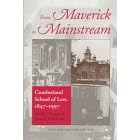
"Prior to the official founding of these first law schools, the primary means for a legal education was apprenticeship. To give some perspective, establishing law schools was difficult in the early 1800s. Harvard only reestablished its law school in 1829 and Yale in 1826. By 1859 Cumberland, Harvard, and the Virginia School of Law were the top three largest law schools in the United States. By 1860 only 21 university law schools existed in the country and in no documented case did the curriculum last over two years." (Wikipedia)
In April 1861, the school's educational mission halted when Abraham Lincoln called for volunteers to serve in the Union Army. Some students joined the Union Army, some the Confederate. The Confederate Army burned the school to the ground during the War, apparently because a Confederate Major was offended that the school had been used to garrison black Union soldiers.

Cumberland as it looked when I was there, 1998-2001
(picture from Wikipedia)
"Cumberland has trained:
2 United States Supreme Court Justices, Howell Edmunds Jackson and Horace Harmon Lurton,
a Nobel Peace Prize recipient,
9 U.S. senators,
Over 40 U.S. Representatives
U.S. Secretary of State, Cordell Hull,
and numerous federal and state judges, representatives and governors.
Cumberland is the first law school to have been sold from one university to another.
Cumberland is well known in the Southeast for its focus on Trial Advocacy.
The school is composed of two buildings: the main classroom building, Memory Leake Robinson Hall, and the Lucille Stewart Beeson Law Library, which is a 42,500 net square foot building with over 300,000 volumes and microform volume equivalents [47].
The school's motto is "Where good people become exceptional lawyers."
Also according to U.S. News & World Report, Cumberland, as of 2006, is tied with Gonzaga University with a 0.21 diversity rating based on a 7% African-American enrollment.
In 2006, the Princeton Review ranked the school 6th in its "Professors Rock (Legally Speaking)" category and 7th in its "Best Quality of Life" category.
Motto: E Cineribus Resurgo means "I rise from the ashes" in Latin and was the motto of Cumberland School of Law following the American Civil War when the campus was burned to the ground by Confederate troops.
One of Cumberland's more notable graduates, Cordell Hull, served under Franklin Delano Roosevelt as Secretary of State and won the Nobel Peace Prize in 1945. At one point in his life he stated that:
"if this historic institution (Cumberland) had been located in any other section of the country instead of having been an unpretentious school in an unpretentious locality, its wonderful work would be as widely known and recognized as that of any educational institution of like age in any part of America."[28]
After witnessing the Civil War, the Great Depression, two world wars, and the Civil Rights Movement, Cumberland stands on a long, proud history, but now looks "to regain the premier status it once held."
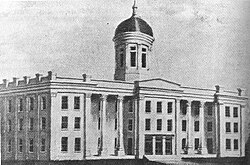 Cumberland University 1858 (picture from Wikipedia)
Cumberland is well known for its emphasis on Trial Advocacy. In 2008, a Cumberland team won the American Association for Justice National Student Trial Advocacy Competition in Fort Lauderdale. 256 teams competed in in this competition, which is generally considered the most prestigious trial advocacy competition in the country. In 2007, student teams from Cumberland won both the Criminal Justice Trial Competition held in Hamden, Connecticut and the Lone Star Classic Mock Trial Competition in San Antonio, Texas. Also in 2008, Cumberland made the finals of the ABA National Appellate Advocacy competition. It was 1 of 4 from 30 teams in its region that went to the national finals. Cumberland won 3rd best brief in the region.
The 2007 Princeton Review features Cumberland in its 2007 edition of "Best 170 Law Schools." Of the 11 ranking lists, Cumberland ranked 6th in the country for faculty performance and accessibility and 7th in the country for overall quality of life. The 2006 Princeton Review ranked the school 6th in its "Professors Rock (Legally Speaking)" category and 7th in its "Best Quality of Life" category." (Wikepedia)
posted by Beth at 7:30 AM


4 Comments:
I'm glad you feel smarter, because you are one of the smartest people I know!
That's awesome! Its always interesting to look back at our old schools and see the history there.
So NOT TRUE, Em, we know MUCH smarter people than me. ;)
Very cool. I love books about school histories. Don't hate me because I'm nerdiful.
Post a Comment
<< Home